AI Lab Blog
AI-Assisted Playbooks Where Humans Stay in Control
February 17, 2026
Tags: Human-in-the-Loop, Governance, SOC
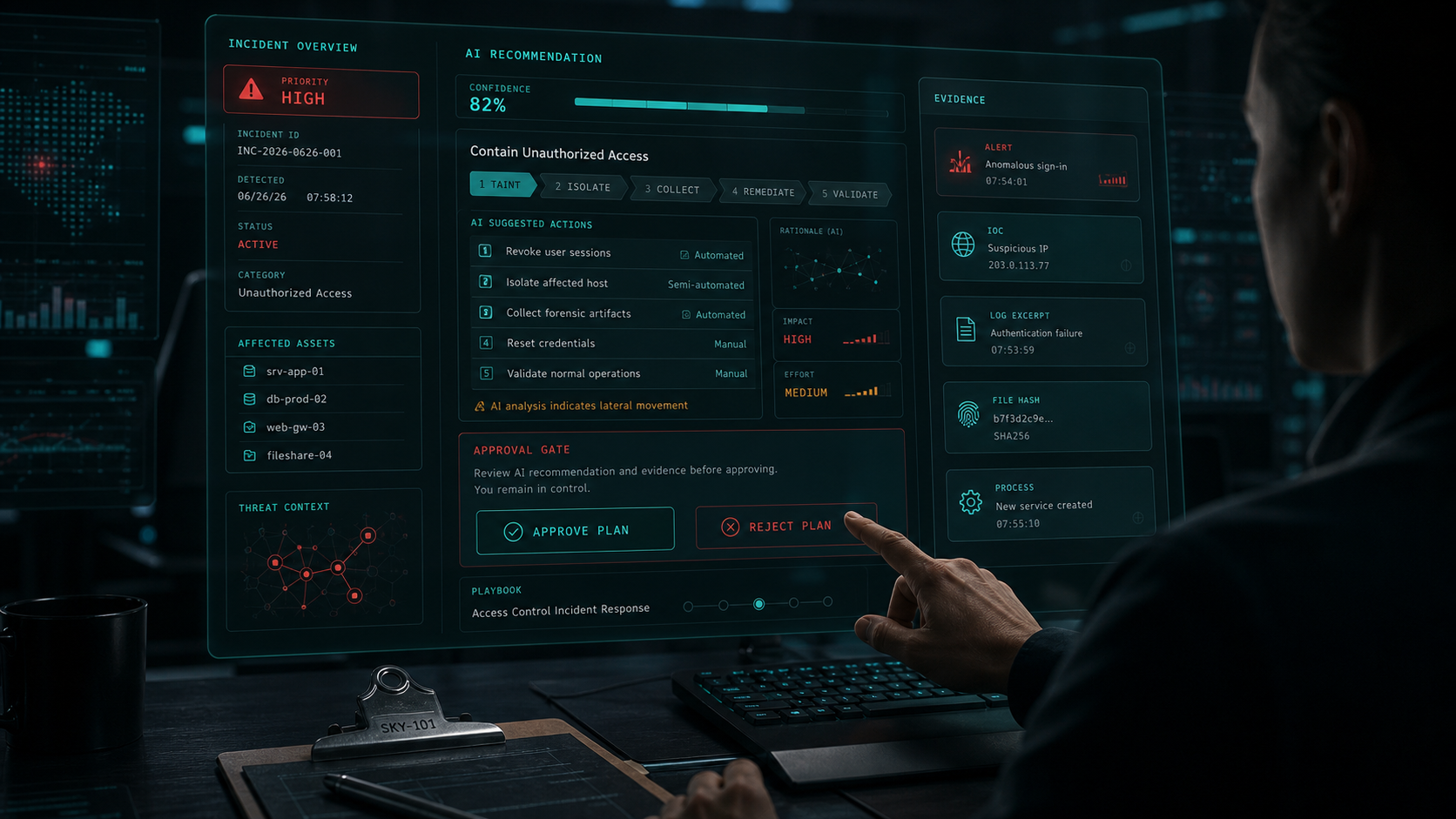
The strongest AI-assisted playbooks do not ask the model to run the incident. They ask the model to reduce the analyst’s cognitive load while preserving the human authority to interpret, approve, reject, and record every meaningful action.
That distinction sounds obvious until a response workflow gets fast. A suspicious PowerShell chain appears. The endpoint tool has a one-click isolate button. The identity platform can revoke sessions globally. The ticketing system wants a severity. The business owner wants an ETA. In that moment, a language model that can summarize, recommend, and draft commands is genuinely useful. It can also become dangerous if the process quietly shifts from “AI recommends” to “AI decides.”
Security teams should not evaluate AI playbooks only by how much time they save. The real measure is whether they improve response quality under pressure while keeping control boundaries visible. A good playbook makes the model’s role boring and explicit: gather context, structure evidence, compare against known patterns, propose options, and draft language. The analyst still decides what is true, what is risky, and what action is authorized.
Where AI belongs in the playbook
The right starting point is to divide a response playbook into decision classes. Not every step carries the same risk. Some steps are informational, some are interpretive, some change system state, and some create business impact.
Informational steps are usually the safest place to begin. The model can summarize an alert, extract entities, normalize timestamps, group related events, and draft a timeline. It is not asserting a final incident determination. It is helping an analyst see the evidence faster.
Interpretive steps require more discipline. The model can compare observed behavior against ATT&CK techniques, identify plausible attack paths, or explain why a command line resembles credential dumping. But every interpretation should include evidence references and uncertainty. If the output cannot point back to source logs, it should be treated as commentary, not analysis.
State-changing steps need approval gates. Host isolation, account disablement, firewall changes, password resets, EDR containment, ticket escalation, and public communications should not execute merely because a model produced a confident recommendation. These steps need named human approval, recorded rationale, and ideally a two-person rule for high-impact actions.
Business-impacting steps need even more caution. Taking down a production service, blocking a partner range, forcing a tenant-wide session revoke, or notifying executives can be the right move. It can also create avoidable harm. The model can prepare the brief. It should not own the call.
The control plane: evidence, options, approval
A useful AI-assisted playbook has three lanes: evidence, options, and approval.
The evidence lane is where raw facts remain visible. Alerts, logs, hashes, IPs, usernames, hostnames, command lines, email headers, cloud events, and case notes should remain linked to their source. The model’s summary is only an overlay. Analysts should be able to click or search from any model claim back to the original record.
The options lane is where the model can be most valuable. Instead of asking, “What should we do?” ask for a menu of actions with tradeoffs. For example:
Given the evidence below, propose three response options.
For each option, include:
- what action would be taken
- what risk it reduces
- what business impact it may create
- what evidence supports it
- what evidence is still missing
- whether the action is reversible
Do not recommend execution. End with questions for the human incident commander.
That prompt does two important things. It turns the model into a staff analyst rather than an unaccountable operator, and it forces uncertainty into the open. The best output is not always the most decisive output. In response work, a useful recommendation often says, “This is likely credential access, but the current record does not prove successful authentication after the event.”
The approval lane is where the workflow must be unambiguous. The interface should show who approved the action, what they approved, when they approved it, and what evidence they saw at the time. If the playbook uses automation, the approval event should be a separate record from the model recommendation. That separation matters during post-incident review.
Design pattern: recommendation cards
One practical pattern is to convert model output into recommendation cards. Each card should have a constrained format:
Recommendation: Isolate host WS-1842 from the network.
Reason: The host executed a suspicious encoded PowerShell command and initiated outbound connections to an IP also seen in two prior alerts.
Evidence: EDR alert 48291, process tree 48291-B, proxy log query 17:20-17:34 UTC.
Confidence: Medium.
Missing context: No memory capture, no confirmation of payload execution, no owner confirmation.
Impact: User loses network access; any active business process on the endpoint may be interrupted.
Reversibility: Isolation can be removed from EDR console.
Required approval: Incident commander or SOC lead.
This format prevents the model from hiding the important parts inside fluent prose. It also creates a reviewable artifact. If the action was right, the team can see why. If it was wrong, the team can inspect which assumption failed.
Failure modes to design against
The obvious failure mode is hallucination. The less obvious failure mode is false completeness. A model may produce a polished incident narrative that feels complete because it has a beginning, middle, and end. Real investigations are often messier. The timeline has gaps. The telemetry is uneven. The endpoint was offline. The identity logs arrived late. A polished story can make uncertainty disappear.
Another failure mode is automation bias. If the model routinely produces good suggestions, analysts may start accepting them too quickly. That risk grows when the user interface frames the model’s answer as the primary object and the evidence as secondary. The evidence should not be hidden behind an expandable panel. For high-risk decisions, evidence should be visible by default.
A third failure mode is prompt drift. Teams often begin with careful prompts and then mutate them under operational pressure. One analyst adds a shortcut. Another removes the uncertainty section because it is verbose. A third asks for direct commands because it saves time. Over time the control model erodes. Prompts used in playbooks should be versioned like detection logic.
The final failure mode is silent execution. If an AI recommendation can directly call a tool, create a firewall rule, isolate a host, or disable an account, the organization needs a strong reason and a compensating control. Most teams should begin with decision support only. Action execution can come later, after the team has evidence that the recommendations are reliable and the approval process is mature.
What to log
AI-assisted response needs its own audit trail. At minimum, capture:
- the prompt template version;
- the model and configuration used;
- the evidence package supplied to the model;
- the recommendation returned;
- the analyst decision;
- any edits to the recommendation;
- the final action taken;
- the outcome observed later.
This data is not bureaucratic clutter. It is how a team learns whether AI is improving response. It also helps separate model error from process error. Did the model miss evidence? Was the evidence never provided? Did the analyst override a good recommendation? Did the approval process slow down containment unnecessarily? Without logs, those questions become hallway opinions.
A practical maturity model
A sensible rollout has four phases.
Phase one is summarization only. The model summarizes alerts, extracts entities, and drafts timelines. No recommendations. No actions.
Phase two adds bounded recommendations. The model proposes options using a strict template, with confidence, evidence, missing context, and business impact.
Phase three integrates approval workflow. Recommendations become structured cards in the case system. Human approvals are logged. Overrides are reviewed.
Phase four adds limited automation for low-risk actions. Examples might include opening a ticket, enriching an indicator, collecting a host triage package, or drafting a notification. High-impact actions remain gated.
This is slower than the fantasy of autonomous response. It is also much closer to how serious security operations actually earn trust.
The bottom line
AI-assisted playbooks should make analysts faster without making them passengers. The model can compress evidence, generate options, and draft response language. The human must own judgment, authority, and accountability.
The future SOC will almost certainly use AI inside its playbooks. The question is not whether AI appears in the workflow. The question is whether the workflow preserves control when the room gets loud.